
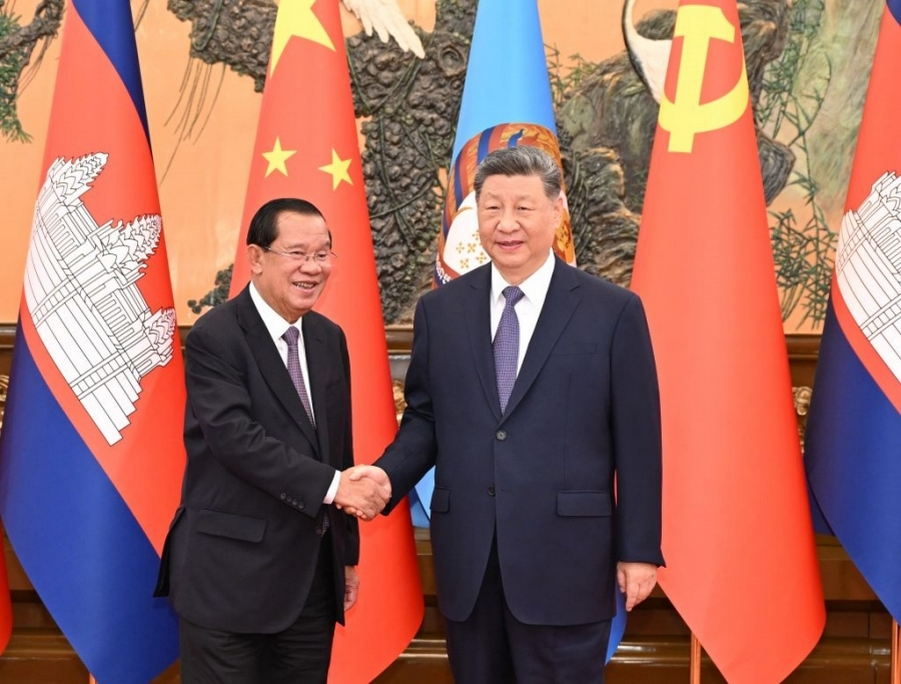
Cambodia and China reinforced one of Southeast Asia’s closest strategic partnerships during high-level talks between Cambodian Senate President Hun Sen and Chinese President Xi Jinping in Beijing, with both leaders pledging to deepen cooperation across trade, investment, infrastructure and regional security.
The meeting comes as China cements its position as Cambodia’s largest trading partner, biggest foreign investor and leading infrastructure development partner, highlighting the growing economic importance of bilateral relations for the Kingdom’s long-term growth strategy.
Xi, who also serves as General Secretary of the Communist Party of China (CPC), described Cambodia-China relations as “as solid as a rock,” reaffirming what both governments continue to characterize as an “ironclad friendship.” The discussions reflected a shared commitment to strengthening the Comprehensive Strategic Partnership and advancing what both sides describe as an all-weather Cambodia-China community with a shared future.
Trade Relationship Continues To Expand
The diplomatic engagement coincides with strong momentum in bilateral commerce.
- According to Cambodia’s General Department of Customs and Excise (GDCE), trade between Cambodia and China reached **$9.39 billion** during the first five months of 2026, representing a **22.9% increase** compared with the same period last year.
- Chinese exports to Cambodia totaled **$8.64 billion**, while Cambodian exports to China reached **$753 million**, underscoring both the rapid expansion of trade and the structural imbalance that continues to characterize the relationship.
- Cambodia recorded a **$7.88 billion trade deficit** with China during the period, reflecting its heavy reliance on imported machinery, industrial equipment and manufacturing inputs that support the country’s expanding industrial sector.
Lor Vichet, Vice President of the Cambodia Chinese Commerce Association (CCCA), expects bilateral trade to continue growing as more Chinese manufacturers establish production facilities in Cambodia to capitalize on the country’s preferential access to global export markets.
China Remains Cambodia’s Largest Investor
Investment flows tell a similarly compelling story.
- According to the Council for the Development of Cambodia (CDC), the country approved **630 investment projects worth approximately $10 billion** in 2025. Chinese investors accounted for **54.25%** of all approved investment capital, maintaining a dominant position among foreign investors.
Hun Sen used the meeting to request continued Chinese support for Cambodia’s infrastructure modernization, emphasizing that Chinese-backed investment has been instrumental in expanding the country’s transportation networks, industrial capacity and overall economic competitiveness.
Alongside the official delegation, Cambodia Chamber of Commerce President Kith Meng is meeting with Chinese business leaders to explore additional opportunities in manufacturing, infrastructure and trade.
Cambodia, Chinese Construction Giant CCCC Reaffirm Infrastructure Partnership
Cambodian Senate President Hun Sen has called on China Communications Construction Company to continue supporting Cambodia’s infrastructure development during a meeting with CCCC Chairman Song Hailiang in Beijing.
Song said CCCC has established 23 subsidiaries in Cambodia, with more than 70% of its workforce made up of Cambodian nationals, and has completed or undertaken around 70 infrastructure projects in the Kingdom over the past two decades. He reaffirmed the company’s commitment to working with the government led by Prime Minister Hun Manet on future projects, including greener infrastructure initiatives.
Hun Sen urged CCCC to maintain progress on key developments, including the Funan Techo Canal, the Phnom Penh–Bavet Expressway, and National Road 50C, saying their completion will strengthen Cambodia’s long-term connectivity and economic growth.
Cooperation Extends Beyond Economics
While economic cooperation dominated the agenda, both leaders also agreed to strengthen collaboration in security, governance and institutional development. The discussions included expanding cross-border security cooperation, improving information sharing between law enforcement agencies and increasing high-level diplomatic exchanges.
The Cambodian People’s Party (CPP) and the Communist Party of China also signed a new memorandum of understanding designed to deepen institutional cooperation, strengthen policy dialogue and provide training opportunities for young political leaders from both countries.
The two leaders additionally exchanged views on regional and international developments, agreeing that increasing geopolitical uncertainty requires closer coordination and stronger cooperation in multilateral forums.
Balancing Opportunity With Structural Challenges
Despite accelerating trade and investment, Cambodia continues to face structural challenges.
The country’s manufacturing sector remains heavily dependent on imported raw materials and intermediate goods from China, limiting domestic value creation and contributing to a widening trade deficit.
Addressing that imbalance will require continued industrial diversification, stronger local supply chains and higher-value manufacturing capabilities. Many economists believe additional Chinese investment in advanced manufacturing, technology and industrial infrastructure could help Cambodia move further up the global value chain.
As Cambodia pursues its ambition of becoming a regional manufacturing and export hub, Hun Sen’s visit underscores that China will remain a central partner—not only diplomatically but also in shaping the Kingdom’s economic transformation over the coming decade.