
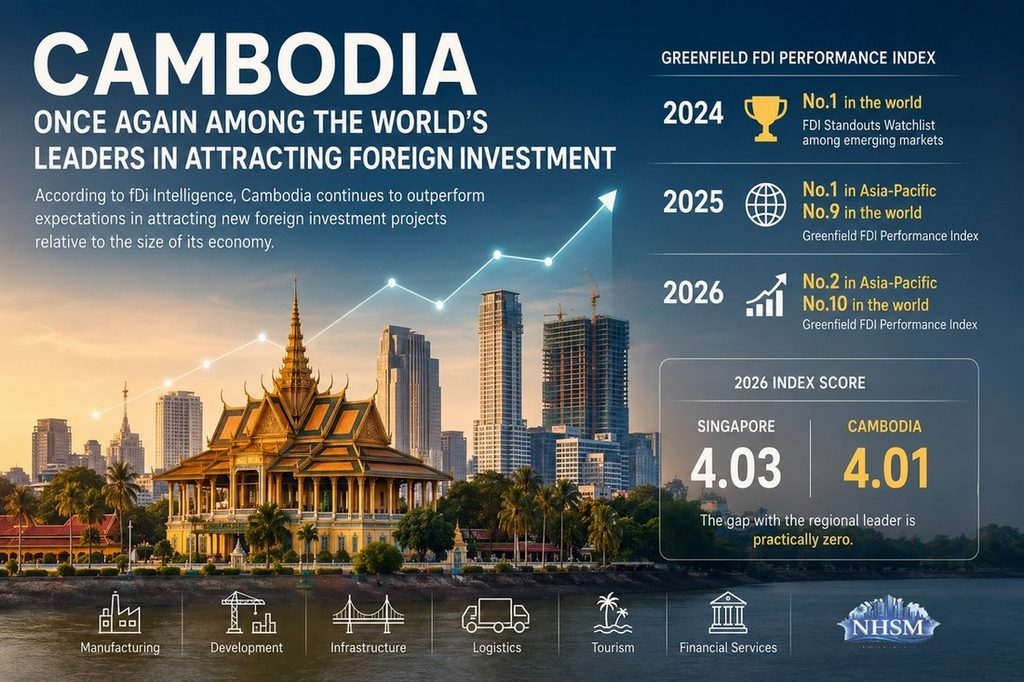
There is a number worth paying attention to. According to FDi Intelligence, the Financial Times investment analysis division, Cambodia has once again demonstrated an exceptional ability to attract new foreign investment projects relative to the size of its economy.
The trend is particularly striking.
- 2024: Cambodia ranked No. 1 globally on the FDI Standouts Watchlist among emerging markets.
- 2025: It ranked No. 1 in the Asia-Pacific region and No. 9 globally on the *Greenfield FDI Performance Index*.
- 2026: Cambodia remained among the global leaders, ranking No. 2 in Asia-Pacific and No. 10 worldwide.
And the regional gap is remarkably narrow.
- Singapore — 4.03
- Cambodia — 4.01
So, what does this number actually mean?
The Greenfield FDI Performance Index measures a country’s ability to attract new foreign investment projects relative to the size of its economy. A score of 4.01 indicates that Cambodia is attracting greenfield investment projects at a level roughly four times higher than might be expected based on the size of its economy.
That is the important part of the story.
Cambodia remains a relatively small economy. Yet international capital is entering the country at a disproportionately high rate.
The sectors are broad: manufacturing, infrastructure, real estate development, logistics, tourism and financial services.
And this is not simply a one-year anomaly.
Cambodia has remained among the world’s strongest FDI overperformers for several consecutive years. For investors, that matters.
Economic transformation rarely happens overnight. It is usually preceded by capital flows, infrastructure investment, new businesses and the expansion of international companies.
This is why Cambodia should not be evaluated solely on what it was 10 or 15 years ago.
The more relevant question is where capital is moving today.
For much of the world, Cambodia is still associated primarily with Angkor Wat, tourism and the image of an emerging Southeast Asian economy.
International business, however, is increasingly looking at something else: a market becoming more integrated into regional supply chains, attracting new investment and building the infrastructure required for its next stage of growth.
For real estate investors, this distinction is particularly important.
Property markets do not develop in isolation. They follow jobs, businesses, infrastructure, tourism, population growth and, ultimately, capital.
Cambodia’s FDI performance does not guarantee that every real estate project will succeed. But it does provide a broader macroeconomic signal worth watching.
Because in emerging markets, one principle tends to remain true: