Let’s explore the full range of costs associated with owning, managing, buying, and selling real estate in Cambodia. From transaction fees and annual taxes to rental obligations and exit expenses, understanding these expenses will help ensure better financial planning and smoother real estate transactions.
With intense urban development and growing demand for real estate in Cambodia, understanding real estate costs and taxes is essential for making sound financial decisions. Understanding current and future market trends helps investors predict the best time to buy and sell their property to maximize their profits . Property prices in Cambodia vary greatly depending on the city, type, and location, as they do in virtually any country.
Operating costs and taxes (purchase and sale)
Stamp duty
The Royal Government of Cambodia has officially confirmed the extension of key tax breaks for the real estate market until December 31, 2026. These breaks include two important incentives that directly impact investment returns and entry costs.

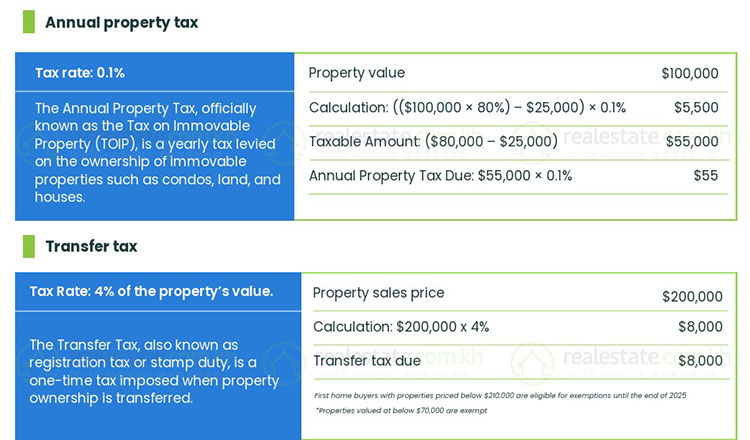
Stamp Duty
 Rate: 4% - incentive valid until: December 31, 2026

- Homebuyers are fully exempt from stamp duty if the property is priced between USD 70,000 and USD 210,000. Within this price range, the stamp duty is 0%.

If the property price exceeds USD 210,000, a 4% stamp duty is paid only on the excess amount, not on the full price.
Agent’s commission (sales and rentals)
When you sell or rent out your home through an agent in the Kingdom of Cambodia, you will be required to pay an agent's commission .

The Ministry has taken immediate measures to ensure that real estate transactions in the market proceed smoothly and benefit both parties—agents and property owners. Typically, sellers pay a sales agent ; buyers pay their own representative .
- Typical commission (on sale): 5% of the sale price (paid by seller or developer)
- Typical Fee (on rental): Typically 1 month’s rent for long-term rentals (paid by landlord)
Capital gains tax
Cambodia currently does not levy a Capital Gains Tax on real estate, as the planned implementation has been postponed several times. Currently, the tax is deferred until January 1, 2027.

This means:
- income from the resale of real estate is not subject to CGT;
- the investor retains 100% of the profit when exiting the transaction during the exemption period.

Capital gains tax in Cambodia is 20% . The tax is calculated on the difference between the sale price and the purchase price.

Therefore, after implementation, capital gains tax will be applied to profits made from the sale of real estate. Taxpayers can choose between a flat 80% deduction or a deduction for actual expenses , supported by documentation, to reduce taxable profits.
Notary fees when purchasing real estate
Notary fees typically amount to 0.5%-1% of the property value (legal expertise, expert advisory assessment, transfer of ownership).
Appraisal fees in Cambodia
Appraisal fees are professional estimates of a property's market value used for sales, financing, or investment analysis. They are charged as a percentage of the property's value :
- • Below $100,000: 0.17% (minimum $170)
- • $100,000 – $1,000,000: 0.1% (minimum $900)
- • From $1 million to $5 million: 0.05% (minimum $2000)
- • From $5 million to $10 million: 0.03% (minimum $1,500)
- • Over $10 million: 0.025%
Legal expertise and notary
These are typically included in the legal and administrative fees and represent minor administrative expenses depending on the property type. A comprehensive due diligence can cost several hundred dollars if performed by a separate firm.
Ongoing costs of owning a property
Property Tax (TOIP Tax)
The annual property tax, officially known as the Tax on Immovable Property (TOIP), is an annual tax levied on owners of real property such as apartments, land, and houses.
The value is determined by the Real Estate Valuation Committee. Key exceptions include real estate with a value equal to or below the threshold, agricultural land actively used for cultivation, properties owned by the government or diplomatic missions, and properties in Special Economic Zones serving agricultural, industrial, or service activities.
- Annual tax: 0.1% of the property value over $25,000.
Tax on rental income
This is a tax on income earned from renting out real estate, and rates vary for residents and non-residents. In the past, there was little enforcement of the tax law, but as Cambodia continues to push for tax reform and increased transparency, stricter enforcement may be introduced in the future.
- Cambodians: 10% of total rental income.
- Citizens of other countries: 14% of total rental income.
Other expenses
- Property insurance: (optional)
- Depreciation fund contribution: a one-time or annual contribution for long-term building maintenance. This reserve fund is collected from owners to cover the costs of major repairs or long-term building upgrades.
- Building management fee: typically $1-2 per square meter per month, includes security, cleaning, and maintenance of common areas.
- Utilities: Electricity and water are subject to usage and are paid by tenants. Standard utility rates are 0.25 per kWh of electricity and 0.35 per cubic meter of water.
VAT (when renting through a company)
- Rental income received through a company is subject to VAT at 10%.
Financing and mortgage costs
For Cambodian citizens:
- Down payment: 20%-30%
- Interest rates: 7-10% per annum
- Mortgage term: up to 20 years
For foreigners shopping in Cambodia:
Foreign nationals have limited access to traditional Cambodian bank mortgages unless the purchase is made through a local company. Foreign buyers must pay 6-8% of the property purchase price for all overt and hidden costs (stamp duty, agency fees, legal fees, administrative fees, and registration fees), not including financing or ongoing taxes. Leading developers offer more sophisticated products and more flexible payment plans . Developer financing options are also available. These may include payment terms of up to 50% of the total payment only upon completion of construction, to reduce buyer risk during the construction phase and build confidence.
Other useful terms to know:
• Sale and Purchase Agreement (SPA) – a legal contract between the buyer and the developer that sets out the terms of payment, transfer and ownership.
• Installment payment – a staged payment model based on construction milestones or a fixed schedule, often used for unplanned purchases.
• Transfer of ownership – legal registration of the property in the buyer’s name, finally formalizing ownership. This begins after full payment and paperwork.
• Payment schedule – the schedule and structure of payments, often divided into a booking, a down payment, stage payments and a final payment.
• Rental Yield – The annual rental income expressed as a percentage of the purchase price of the property. For example, $12,000 income on a $150,000 property = 8% yield.