In Phnom Penh’s evolving commercial real estate market, investors are no longer focused solely on location and rental yields. Increasingly, risk management and capital protection have become equally important factors when evaluating investment opportunities.
This is where Odom Tower distinguishes itself
Rather than positioning itself as a conventional office development, Odom Tower presents a more structured investment model, combining Grade-A office fundamentals with built-in financial safeguards designed to reduce investor risk.
Rising 45 storeys above Phnom Penh’s central business district, the project will deliver approximately 43,000 sqm of strata-title office space, allowing investors to own office units outright rather than simply participate in a leasehold structure. This creates flexibility for owner-occupation, leasing, or long-term capital appreciation.
Why Odom Tower Stands Out
Prime CBD Location
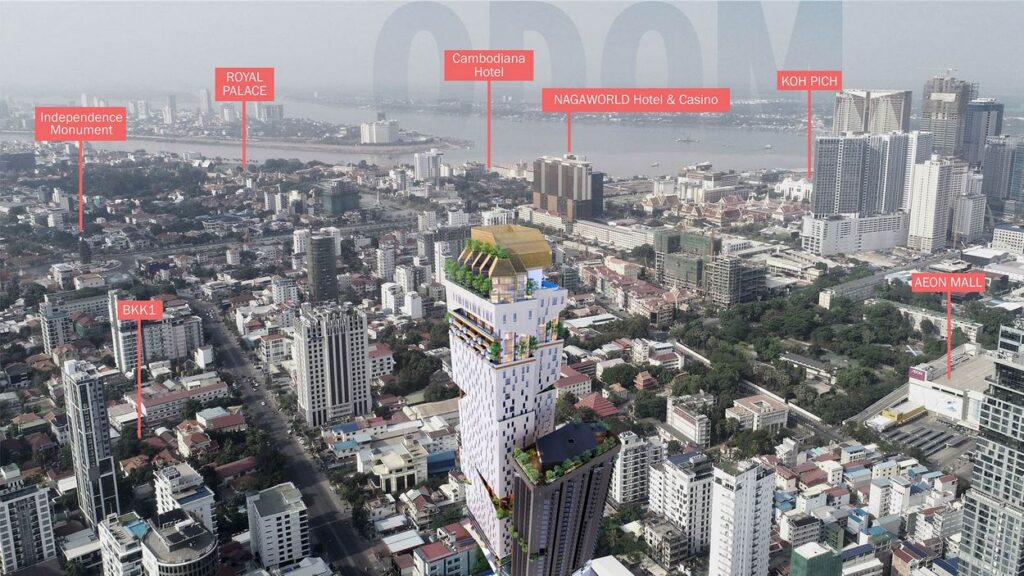
Strategically located along Norodom Boulevard, Odom Tower sits within one of Phnom Penh’s most established business and diplomatic corridors.
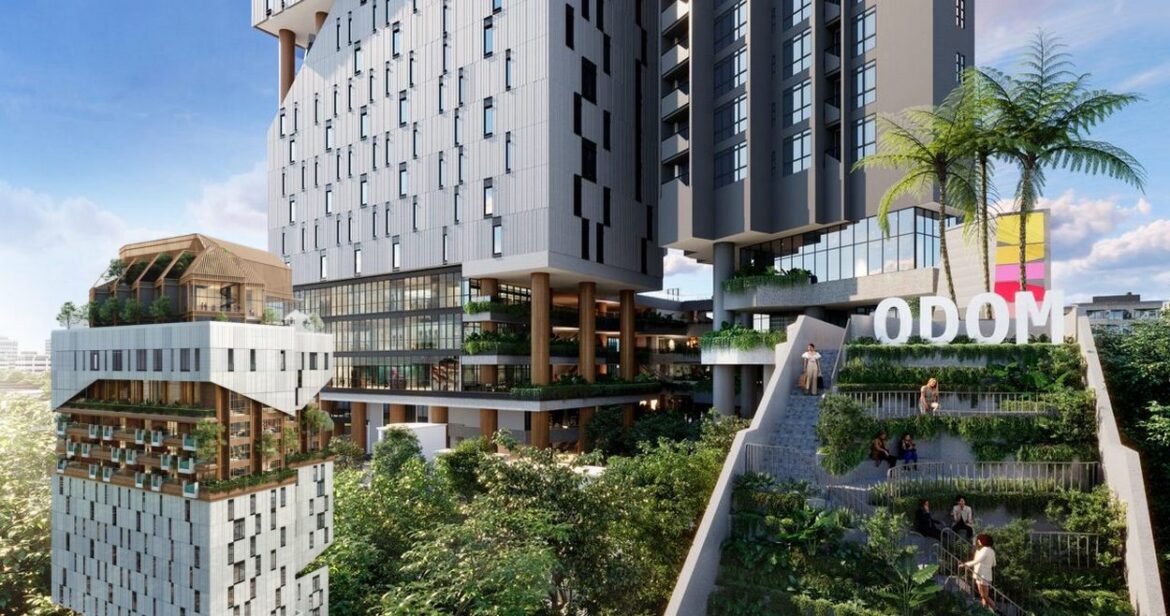
The surrounding area is home to embassies, NGOs, multinational companies, financial institutions, and premium residential developments, creating natural demand from long-term, high-quality tenants. Its direct integration with Odom Square further enhances the project’s appeal by adding retail, dining, and lifestyle conveniences increasingly expected by modern businesses and employees.
About the project:
Experienced Developer with Proven Execution
The project is developed by Urban Living Solutions (ULS), a developer with an established track record in Cambodia’s real estate and hospitality sectors.
The company’s portfolio includes successful hospitality and mixed-use projects across Phnom Penh and Siem Reap, including Velea and Rose Apple Square. For investors, this operational history is significant because it demonstrates the developer’s ability to execute and manage income-generating assets, not simply launch projects.
International Grade-A Standards
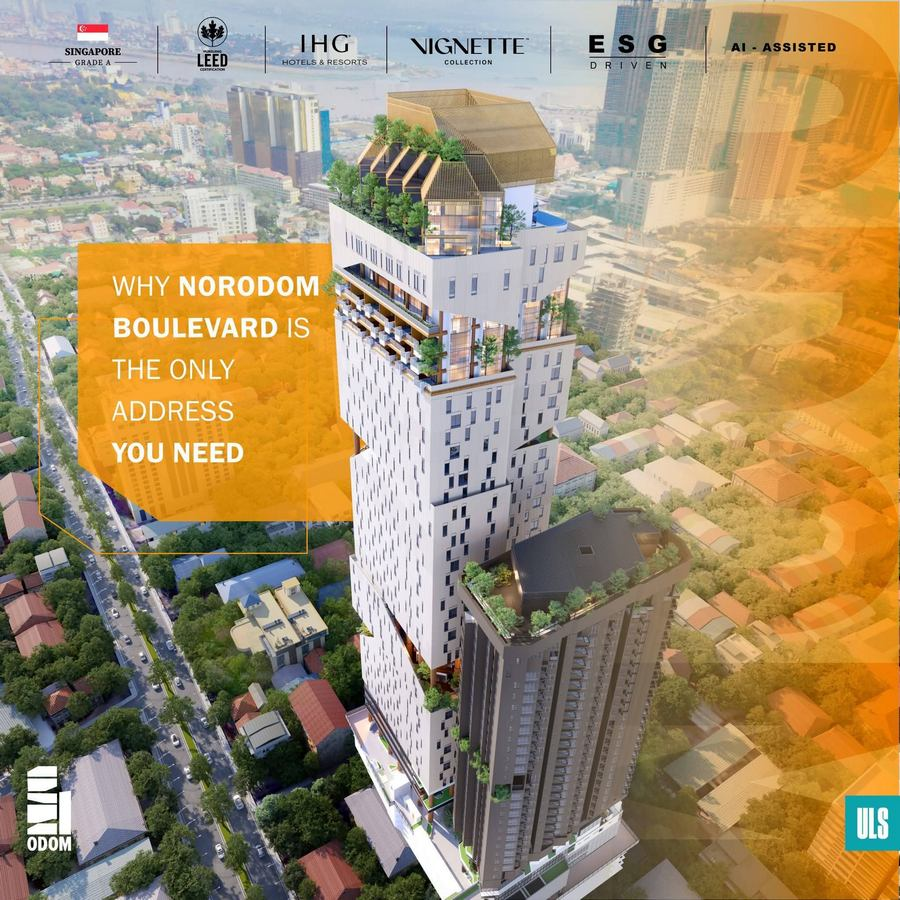
Odom Tower is being developed to international Grade-A office standards, with a targeted LEED Gold Certification, reflecting growing demand for sustainable, future-ready office environments in Southeast Asia.
Key features include:
- 45-storey office tower
- Approximately 43,000 sqm of office space
- Flexible office configurations, including subdivided units and full-floor options up to 1,515 sqm
- “Sky village” concept designed to encourage collaboration and networking
- Smart elevator systems and 24/7 security
- Professional reception and concierge services
- Rooftop members’ club for business engagement and networking
These elements position the tower to attract multinational corporations, regional firms, and modern professional tenants seeking premium office environments.
A Safer Office Investment with GRR & GBB – ODOM Tower
Operational Quality That Supports Tenant Retention
Beyond aesthetics, the development focuses heavily on operational efficiency and tenant comfort — factors that directly influence occupancy stability and rental performance.
Features include:
- Raised flooring for simplified infrastructure installation
- Shared pantry facilities on every floor
- Bicycle parking and shower facilities
- Free Wi-Fi in common areas
While often overlooked, these practical details significantly improve the tenant experience and help support long-term occupancy rates.
Integrated Business Ecosystem
One of the project’s more distinctive characteristics is its emphasis on community-driven workspace design.
Through its integration with Odom Square and its internal “sky village” concept, the tower aims to create a connected business ecosystem rather than a standalone office building.
For tenants, this provides:
- Improved workplace convenience
- Enhanced networking opportunities
- Better employee experience and retention
For investors, stronger tenant engagement often translates into longer lease durations and improved occupancy stability.
The Investment Structure: GRR + GBB
For many international investors entering emerging markets, two questions remain central:
- Can the investment generate predictable income?
- Is there a reliable exit strategy?
Odom Tower addresses both concerns through a dual structure combining Guaranteed Rental Return (GRR) and Guaranteed Buyback (GBB).
Guaranteed Rental Return (GRR)
The Guaranteed Rental Return structure provides investors with a fixed rental yield for a specified period, reducing concerns around early-stage vacancy or tenant sourcing.
This creates a more predictable cash-flow profile, particularly valuable in a developing office market where supply remains relatively limited.
Importantly, the project’s investment case is not based solely on the guarantee itself. The underlying fundamentals — CBD location, Grade-A design, integrated retail ecosystem, and proximity to key institutions — are the same factors that support genuine tenant demand over the long term.
Guaranteed Buyback (GBB)
Equally significant is the Guaranteed Buyback structure.
Under this model, the developer offers investors the option to sell their units back at a predetermined price after a certain holding period. This reduces dependence on short-term market liquidity and provides investors with a clearer exit pathway.
For foreign investors unfamiliar with Cambodia’s secondary office market, the buyback mechanism serves as an additional layer of downside protection while still allowing participation in potential capital appreciation.
Why the Guarantees Matter
In real estate, guarantees are only meaningful if supported by credible financial capacity.
In Odom Tower’s case, the structure is reinforced by ULS’s diversified revenue base, including retained ownership of retail and hospitality assets within its broader portfolio. These recurring income streams help support the long-term sustainability of both the rental return and buyback programs.
This makes the guarantees appear less like a marketing tool and more like a financially structured investment mechanism backed by operational assets.
Strong Phnom Penh Office Market Fundamentals
The broader office market also supports the investment thesis. Phnom Penh’s Grade-A office segment continues to demonstrate relatively limited supply compared to long-term demand expectations.
Current market indicators include:
- Grade-A office rents averaging approximately US$25–30 per sqm/month
- Total Grade-A supply remaining relatively constrained
- Growing demand from regional companies, professional services, and international organizations
Over the coming years, well-positioned projects such as Odom Tower could benefit from:
- Rental growth
- Increasing occupancy demand
- Long-term capital appreciation
- Strengthening relevance within Phnom Penh’s evolving CBD
Final Thoughts
For investors evaluating Cambodia’s commercial real estate sector, Odom Tower presents a combination that remains relatively uncommon in emerging markets:
- Prime CBD positioning
- Experienced developer with operational track record
- International Grade-A specifications
- Tenant-focused ecosystem design
- Structured downside protection through GRR and GBB
As Phnom Penh continues to mature as a regional business destination, projects that combine strong fundamentals with risk-mitigation mechanisms are likely to attract increasing attention from both local and international investors.
Come Home to Cambodia – ULS Projects, video
ODOM Tower, Living, Square – Rose Apple Square – Bakong Village – Urban Village 2